Flexible Contamination Control
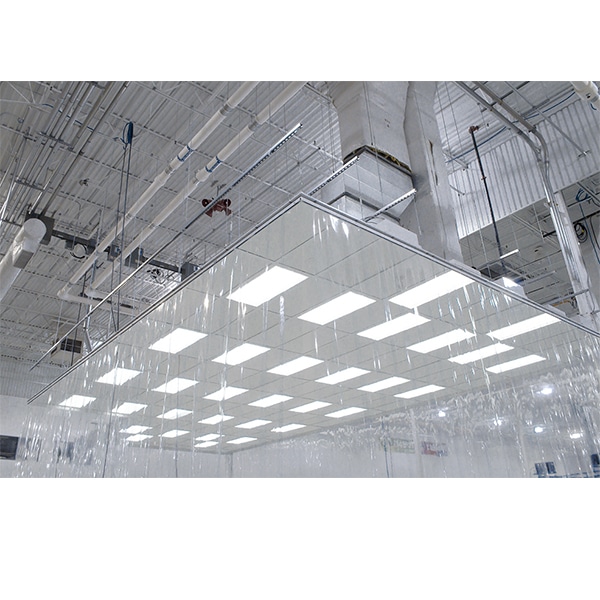
The Ceiling Suspended Softwall Cleanroom is the ideal choice for manufacturers who need the protection of a cleanroom but cannot commit to a permanent hardwall or floor-supported structure. This “room-within-a-room” utilizes your existing building’s height to create a pressurized, filtered zone.
Key Advantages
-
Cost Efficiency: By utilizing existing building structures, these units often require fewer raw materials than floor-supported models, offering significant cost savings.
-
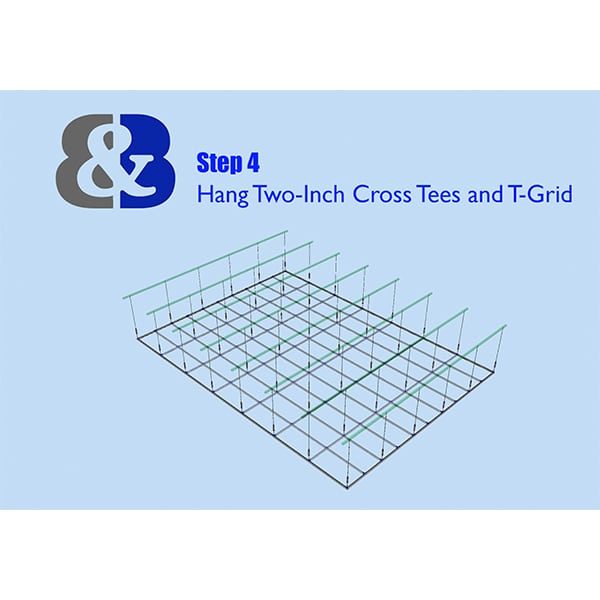
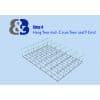
Customizable T-Grid: Features a heavy-duty aluminum Grid system that supports both the Ceiling Lights, Filtration Units, and Ceiling Panels.
-
High-Flow Filtration: Designed to house both Q-Series (Three Speed) and M-Series (Variable Speed) FFUs to maintain precise ISO air quality standards.
-
Clear 40 Mil Vinyl: Standard enclosures use high-grade Curtains that provide 360-degree visibility for safety and operational monitoring.
Structural Requirements
Because this system is “hung,” the integrity of the installation depends on your building’s joists. Our team provides the layout and hardware specs to ensure a level, secure, and airtight installation.
Suspended System Technical Specifications
Our ceiling-suspended systems are engineered to provide a high-performance “clean zone” while maintaining a completely clear floor-space. These specifications outline the structural and mechanical requirements for a standard suspended installation.
Suspension & Framework
-
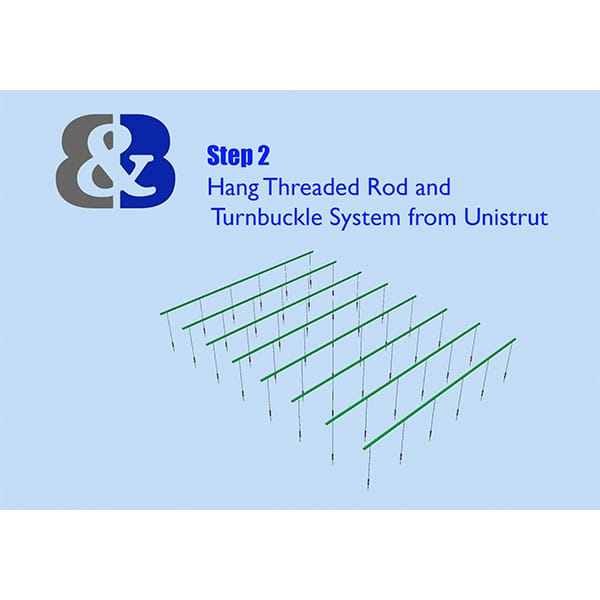
Support Method: Designed to be suspended from overhead building joists using 3/8″ threaded rods or high-strength aircraft cable (depending on clearance and load requirements).
-
Main Chassis: Features a heavy-duty, clear anodized aluminum Grid system that acts as the primary structural frame.
-
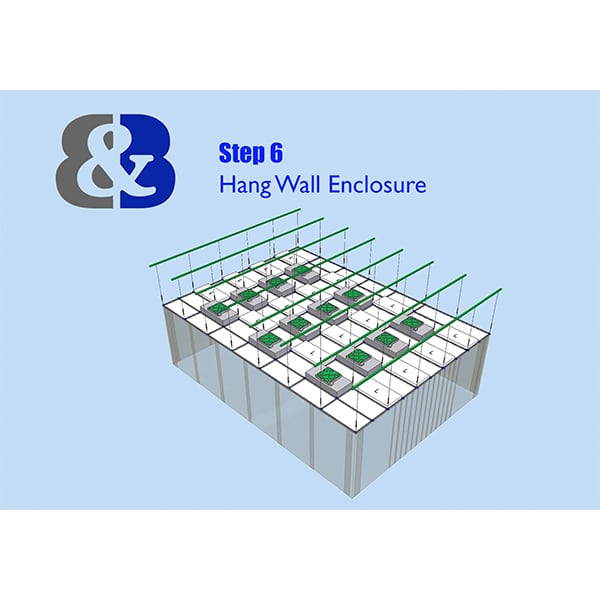
Perimeter Framing: Lightweight white painted steel or aluminum perimeter tracking to secure the Curtains.
Containment & Environment
-
Curtain Material: Enclosed with clear 40 mil vinyl Curtain Panels.
-
Entry/Exit: Features a 4’ wide strip door consisting of 8” wide, 80 mil clear vinyl strips with a 2” overlap for easy personnel and equipment access.
Filtration & Airflow
-
FFU Compatibility: Engineered to support 2’ x 4’ HEPA Fan Filter Units.
-
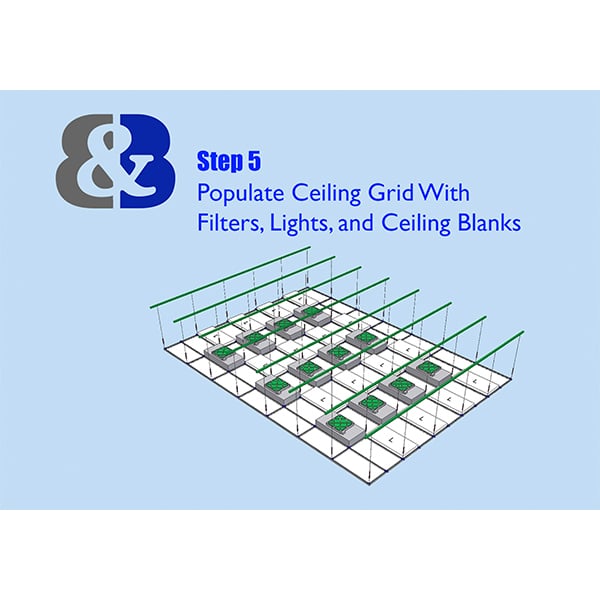
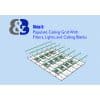
Ceiling Seal: All non-mechanical grid spaces are filled with Ceiling Panels featuring a vinyl-laminated surface and sealed edges to ensure 100% plenum integrity.
Illumination & Electrical
-
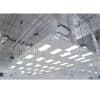
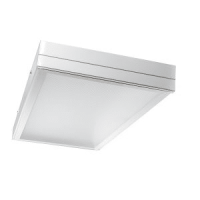
Lighting: Includes 2′ x 4′ cleanroom-grade LED Ceiling Lights. These fixtures are flush-mounted to the Grid to provide uniform, shadow-free lighting.
-
Wiring: Standard units are provided with power cords for the FFUs and Lights. Final integration into the building’s electrical system should be performed by a licensed electrician.
Standard Dimensions
Custom Engineering
Because every building’s structural layout is different, we provide a custom suspension layout with every order. If you have specific height requirements or obstructions like HVAC ducting, please Contact Our Engineering Team.
Understanding Cleanroom Classifications
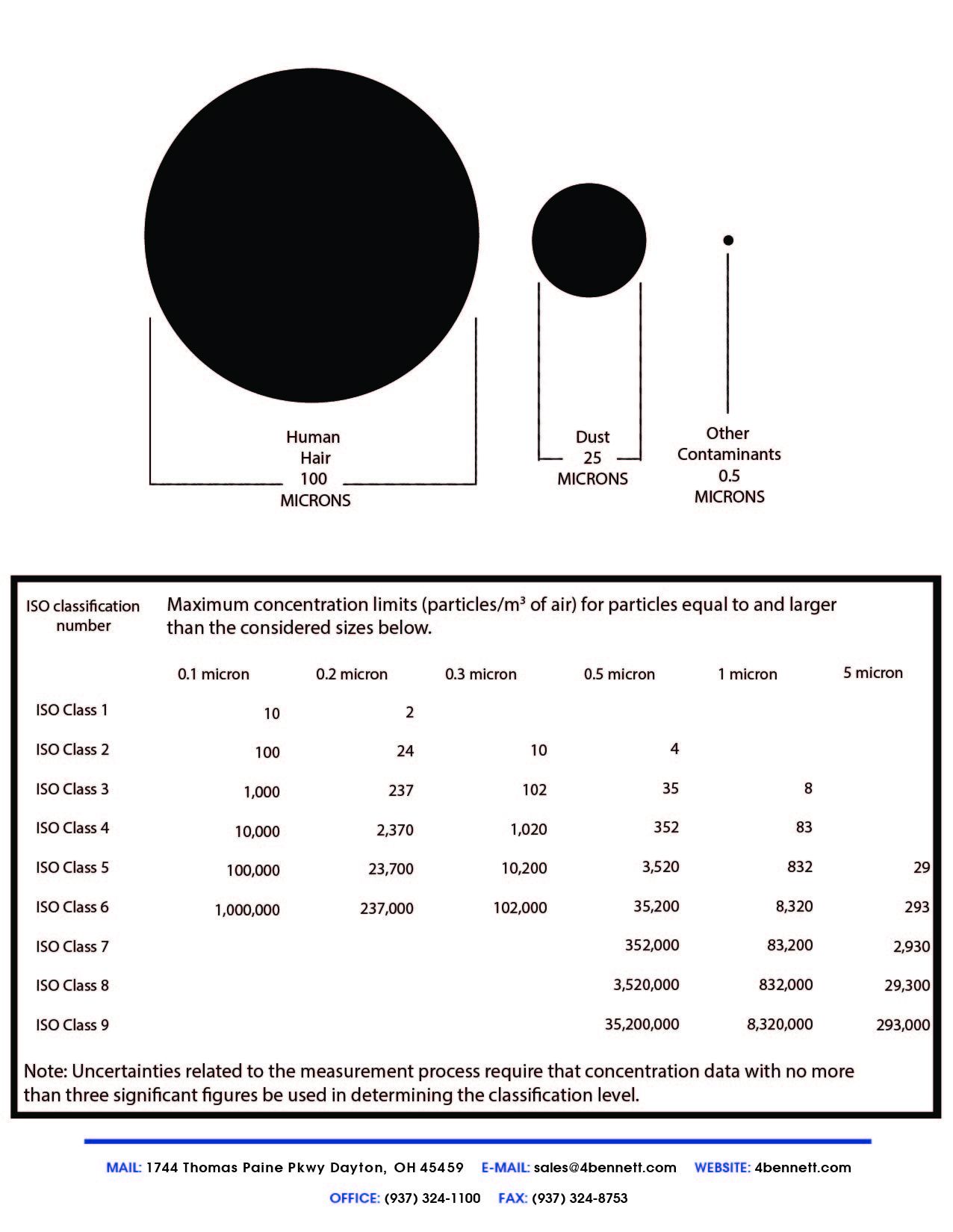
Choosing the right cleanroom depends entirely on the sensitivity of your process. Our Modular Softwall Clean Rooms are designed to be scalable, allowing you to achieve standards from ISO 8 (Class 100,000) down to ISO 4 (Class 10).
How to Determine Your Requirements
To select the appropriate room, you must identify the maximum allowable particle count for your specific application.
Example Case Study:
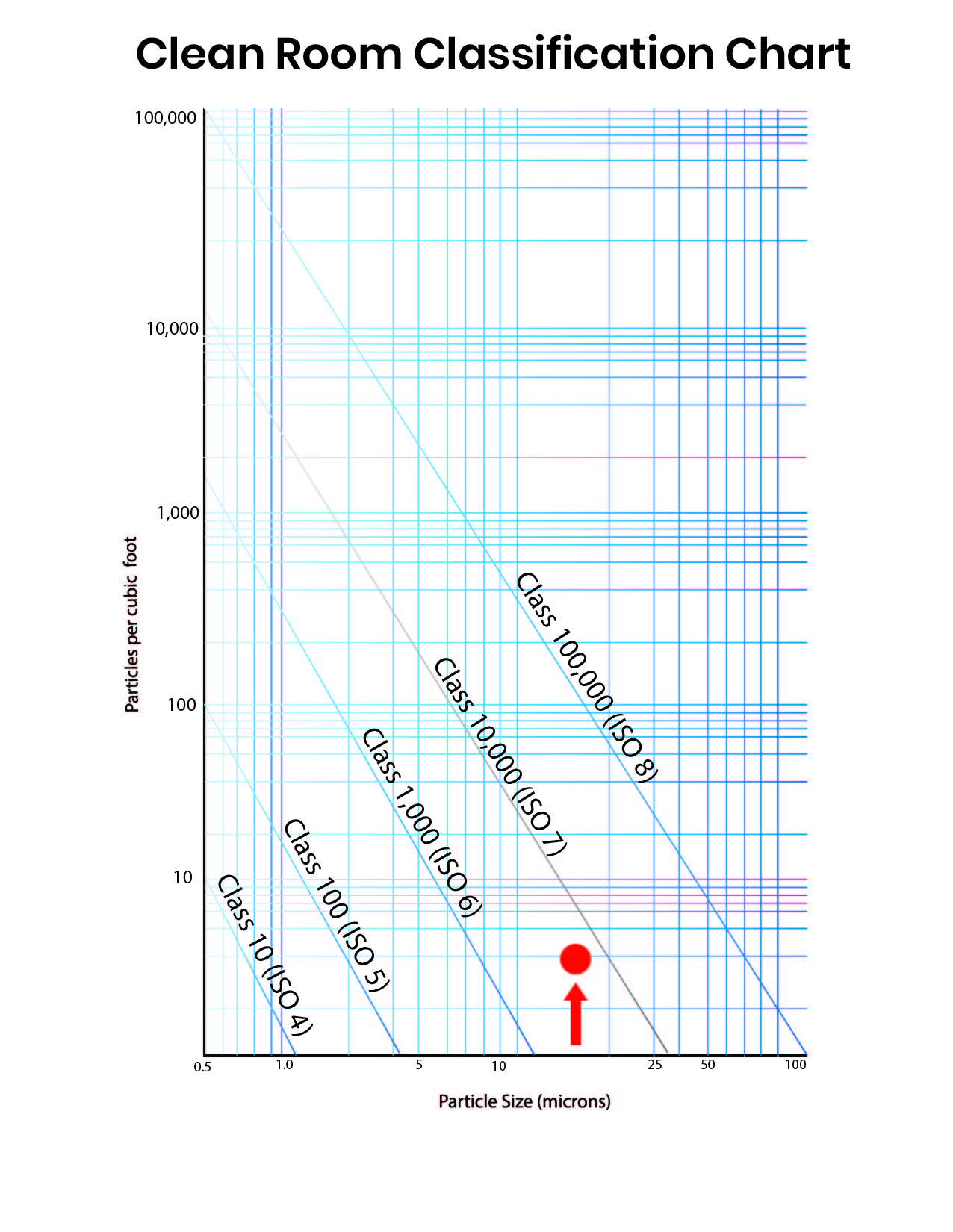
Imagine a manufacturer of precision optical lenses. They are experiencing contamination from dirt particles (15-30 microns in size) that are visible to the naked eye. In a standard uncontrolled environment, these particles might number 5,000–7,000 per cubic foot.
-
By consulting the Clean Room Classification Chart below, the manufacturer can see that an ISO 6 (Class 1,000) room is required to drop that count to under 10 particles per cubic foot, effectively eliminating the production defect.
ISO Standards vs. Federal Standard 209E
While the industry has transitioned to ISO 14644-1 standards, many facilities still refer to the older Federal Standard 209E. Here is how our systems typically categorize:
| ISO Class |
Fed Standard Equivalent |
Common Applications |
| ISO 8 |
Class 100,000 |
General Warehousing, Plastic Injection Molding |
| ISO 7 |
Class 10,000 |
Medical Device Assembly, Precision Engineering |
| ISO 6 |
Class 1,000 |
Electronic Manufacturing, Optics, Pharmaceuticals |
| ISO 5 |
Class 100 |
Aisle-filling for Semi-conductors, Biotechnology |
The Role of Air Changes per Hour (ACH)
Achieving these classifications is a result of the “Air Changes per Hour” provided by your Fan Filter Units.
-
To reach an ISO 7 rating, the air in your Softwall Cleanroom needs to be filtered and replaced roughly 60 to 90 times per hour.
-
Our Q-Series and M-Series FFUs are specifically mapped to these requirements to ensure your room stays within compliance.
Pro Tip: Higher ISO classifications (like ISO 5 or 6) require more Fan Filter Units and tighter Grid spacing. If you are unsure which level your industry requires, contact our specialists for a consultation.
Engineering Your Suspended Environment
A Ceiling Suspended Softwall Cleanroom is a precision-engineered system. Because it lacks floor support, every component—from the suspension wires to the ceiling panels—must be perfectly synchronized to maintain structural levelness and internal air pressure.
1. The Suspension Infrastructure
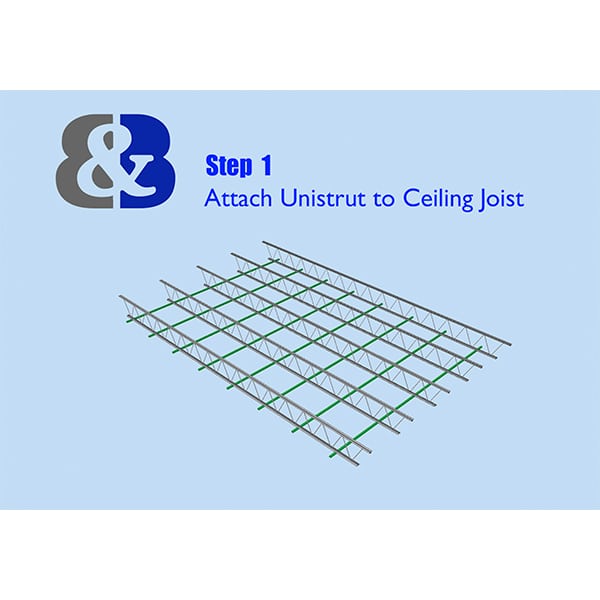
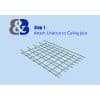
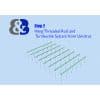
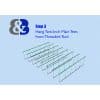
The build begins with high-strength threaded rods or aircraft cables anchored to your facility’s joists. This infrastructure supports the Cleanroom Grid, which acts as the “chassis” for your cleanroom. Our engineering team provides the spacing requirements to ensure the weight of your filters and lights is distributed safely.
2. Specialized Airflow & Filtration
To achieve your desired ISO classification, we integrate high-efficiency Fan Filter Units directly into the suspended grid.
-
Q-Series FFUs: The standard for energy-efficient, low-noise operation.
-
M-Series FFUs: Recommended for suspended rooms that require automated pressure monitoring or variable speeds.
3. Sealing the Plenum with Ceiling Panels
In a suspended room, maintaining “positive pressure” is vital so that filtered air pushes out contaminants. Any grid space not used by a filter or light must be filled with our Ceiling Panels. These panels feature a non-shedding, vinyl-laminated surface that creates a tight seal against the grid gaskets.
4. Lighting and Visibility
-
Illumination: We use flush-mounted LED Ceiling Lights that sit perfectly level with the grid, ensuring no shadows or “dead zones” in your workspace.
-
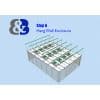
Containment: The perimeter is enclosed with clear 40 mil Curtains, which are custom-weighted to prevent “blow-out” from the internal air pressure while allowing for 360-degree visibility.
Why Choose a Suspended System?
-
Zero Floor Obstructions: Ideal for placing cleanrooms over existing conveyors or large machinery.
-
Easy Expansion: Simply add more suspension points and grid sections to grow your clean zone.
-
Rapid Cleanliness: Because the system is modular, it can be installed in a fraction of the time required for a hardwall build.
Structural Consultation Required Every suspended room is unique to the building it inhabits. To ensure your ceiling can support the weight of the system, Contact our Engineering Team for a structural load-bearing assessment and custom layout.
Next Step:
Request a Quote for Your Suspended System
Suspended Cleanroom Shipping & Logistics
Shipping a Ceiling Suspended Softwall Cleanroom requires specialized packaging to protect the structural integrity of the ceiling Grid and the sensitive internal components. We ensure every “room kit” is consolidated and crated to minimize the risk of transit damage.
Freight and Packaging
-
LTL Freight Delivery: Due to the dimensions of the grid tees and the weight of the filtration units, these systems ship via LTL (Less Than Truckload) Freight.
-
Protective Crating: Your order is shipped in reinforced crates. This includes custom-wrapped Curtains to prevent creasing and heavy-duty boxing for Ceiling Lights and HEPA Fan Filter Units.
-
FOB Point: All orders are shipped FOB Yellow Springs, OH.
Delivery Site Requirements
-
Loading Dock/Forklift: A loading dock is highly recommended. Because the crate dimensions for suspended rooms often exceed the size of standard truck liftgates, a forklift is typically required for safe offloading.
-
Structural Inspection: Upon arrival, please inspect all long-span components (Grid) for any signs of bowing or bending. Any discrepancies or damage must be noted on the Bill of Lading (BOL) before the driver leaves the site.
Shipping Quotes
Freight charges are calculated based on the total weight of the kit and the delivery distance. To receive a complete landed cost:
-
Determine your required ISO Class and room footprint.
-
Request a Formal Quote.
-
Our team will provide a competitive freight estimate tailored to your facility’s requirements.
Lead Times
Standard suspended kits typically ship within 30 business days. For custom configurations or large-scale projects, please contact us for a specific production timeline.
Logistics Support
If you are coordinating a complex installation or have restricted delivery hours, please Contact our Logistics Team to discuss specialized shipping arrangements.




Reviews
There are no reviews yet.